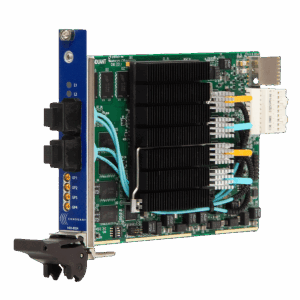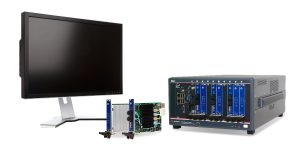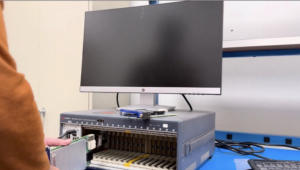
In February 2026, researchers at Kyoto University’s Graduate School of Informatics announced a landmark result in 6G wireless research: ultra-wideband THz signal transmission at 14.6 Gbit/s, across a 7.8 GHz bandwidth, with reliable performance at simulated mobility speeds up to 1,000 km/h. The recording/playback system at the heart of that testbed is the Conduant Cobra recording system.
Why the Terahertz Band Is Central to 6G
To understand the significance of the Kyoto research, it helps to understand the spectrum problem 6G is being built to solve.
Current 5G networks operate across two primary frequency ranges. Sub-6 GHz spectrum (roughly 3.6–4.9 GHz in Japan) provides broad coverage but limited bandwidth — channels top out at around 100 MHz. Millimeter wave spectrum, centered around 28 GHz, opens up wider channels — up to 400 MHz per channel — but suffers from limited range and penetration. As 5G deployments expand globally and data demand continues to grow, even millimeter wave bands are expected to face congestion.
The terahertz band — frequencies from roughly 100 GHz to 3 THz — represents the next frontier. Operating at frequencies approximately ten times higher than millimeter waves, THz spectrum enables channel bandwidths tens of times wider than anything currently allocated for 5G. That headroom is what makes THz attractive for applications like ultra-high-definition wireless video transmission, ultra-high-speed wireless backhaul links, and the high-throughput data links required by next-generation non-terrestrial networks (NTNs) — satellites, high-altitude platforms, and airborne relay systems.
The challenge is that THz wireless communication at this scale has never been demonstrated in a form that conforms to the standards 6G will need to build on. Prior experimental THz systems either used non-standard modulation schemes, or operated within bandwidths that didn’t significantly exceed what 5G already achieves. The Kyoto research changes that.
What the Kyoto University Team Achieved
The research group led by Professor Hiroshi Harada and Associate Professor Yusuke Koda built a THz wireless transmission testbed using software-defined radio technology. Their goals were specific: demonstrate ultra-wideband signal transmission compliant with existing 5G physical-layer standards, at bandwidths that dwarf current 5G allocations, under environmental conditions simulating the extreme mobility scenarios 6G must support.
The testbed operates at a center frequency of 300.24 GHz — well into the terahertz band. Key results:
|
Transmission Bandwidth
7.8 GHz
~20× wider than Japan’s current 5G maximum of 400 MHz per channel
|
Data Rate
14.6 Gbit/s
Achieved using QPSK modulation and LDPC FEC under 5G NR OFDM
|
|
Center Frequency
300.24 GHz
Terahertz band, ~10× higher than millimeter wave
|
Max Mobility Emulated
1,000 km/h
Covering NTN, satellite, and high-speed terrestrial scenarios
|
The system uses 680 resource blocks with a subcarrier spacing of 960 kHz — an 8× increase over the 120 kHz maximum currently defined in 5G NR standards. This modification was necessary to maintain OFDM coherence across the wider THz bandwidth while preserving compliance with the 5G NR physical-layer framework.
5G NR Standard Compliance
Previous THz demonstrations typically used custom modulation schemes because adapting 5G OFDM to THz conditions is technically difficult. The Kyoto team did it. This matters because 6G is expected to evolve from 5G rather than replace it, meaning THz systems that cannot interoperate with 5G NR signal formats have limited practical value for real deployment pathways.
The High-Mobility Problem in THz Communications
THz signals are extraordinarily sensitive to Doppler effects. When a transmitter and receiver are moving relative to each other, the received carrier frequency shifts proportionally to both the relative velocity and the carrier frequency itself. At 300 GHz, even moderate speeds produce Doppler shifts large enough to destroy OFDM synchronization if not compensated for.
For non-terrestrial network applications — low Earth orbit satellites, high-altitude pseudo-satellites, airborne relay platforms — relative speeds between the ground terminal and the airborne node can approach or exceed 1,000 km/h. Standard 5G signal processing methods, developed for millimeter wave and sub-6 GHz frequencies, fail at these speeds in the THz band. In testing, the Kyoto team demonstrated that conventional carrier frequency offset compensation broke down completely in the 700–1,000 km/h range, pushing block error rates well above the 10% threshold required for reliable communication.
Their solution was to develop and implement a new signal processing scheme directly in the ultra-wideband software defined radio — using the Keysight and Conduant hardware for real-time playback and capture of the signals. The new algorithm automatically estimates and compensates for carrier frequency offset across the full tested mobility range. With this method in place, the testbed maintained block error rates below the 10% threshold at all speeds tested up to 1,000 km/h, including conditions where conventional methods failed completely.
This is not a simulation result.
It was demonstrated on physical hardware in a laboratory environment, using recorded signals and a precisely controlled AWGN noise channel at −0.4 dB SNR — a demanding operating point that stress-tests the receiver chain under realistic noise conditions.
Conduant’s Role in the Testbed
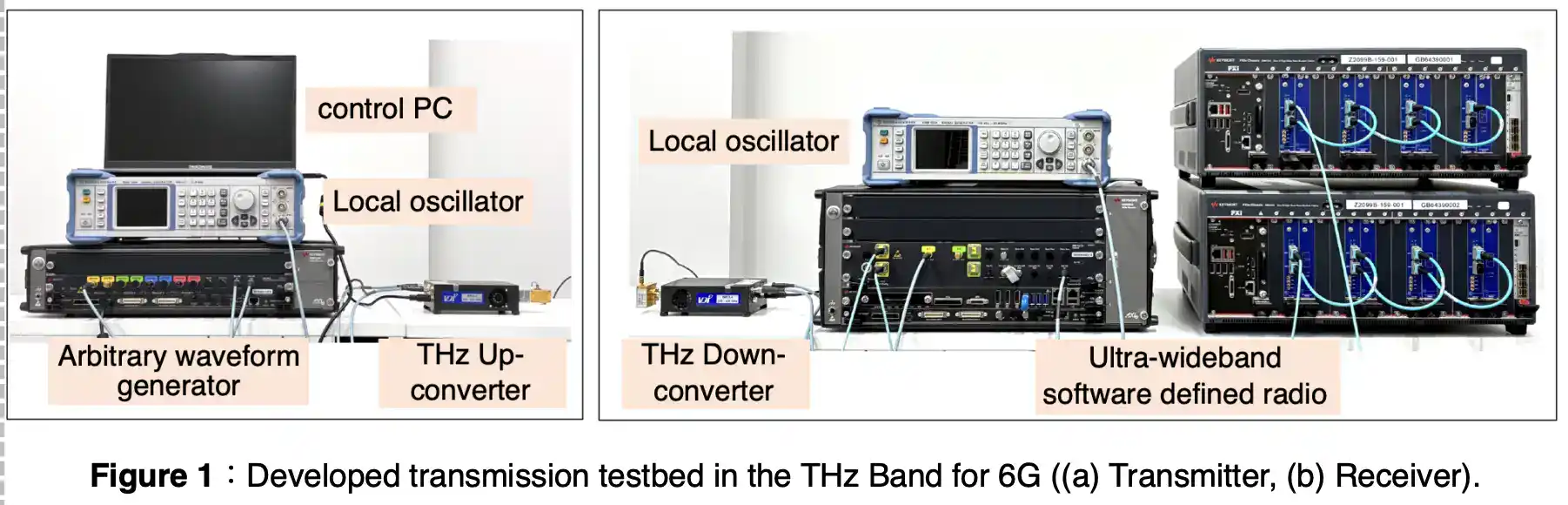
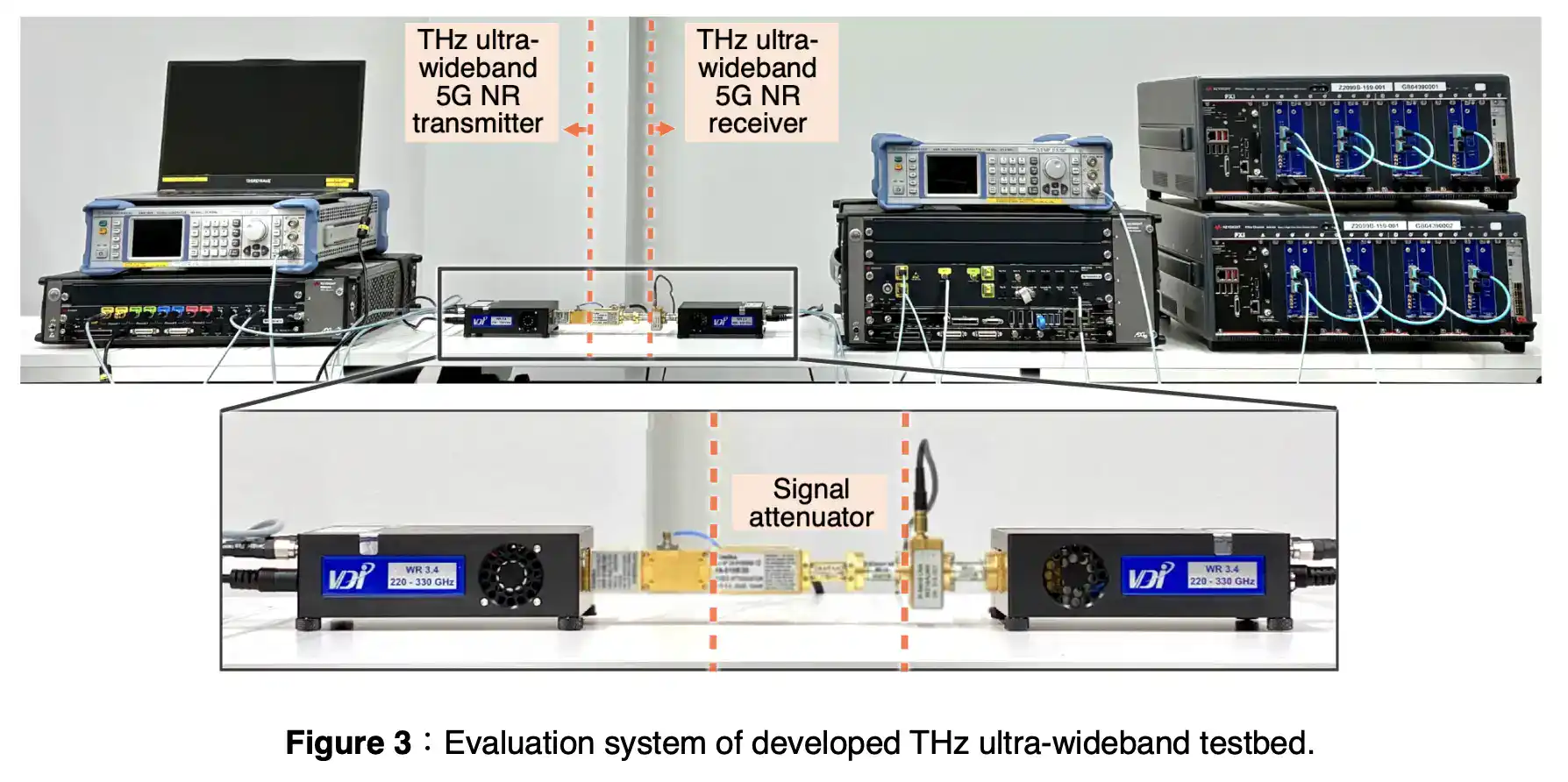
The Kyoto University press release identifies the ultra-wideband software defined radio as the core signal processing component of the receiver. Conduant’s hardware is visible and labeled in the testbed photographs and system diagrams published in the official press release.
The receiver configuration combines a THz downconverter — which translates the 300 GHz signal down to a processable intermediate frequency — with Keysight’s ultra-wideband SDR platform, which handles digital signal processing, carrier frequency offset estimation and compensation, OFDM demodulation, and data recovery across the full 7.8 GHz bandwidth.
This is exactly the kind of application Conduant’s hardware is engineered for: real-time, sustained, high-throughput signal capture and playback in environments where off-the-shelf platforms cannot keep pace. The bandwidth requirements alone — 7.8 GHz at an 8 GHz sampling rate — push well beyond what most commercial SDR systems can handle. The additional requirement to implement novel real-time carrier frequency offset compensation at THz frequencies makes the demands even more specific.
The testbed deployment also reflects the Conduant-Keysight Technologies partnership in practice. Hiroshi Sakuma of Keysight Technologies Japan’s APS Solution Engineering organization supported the deployment of Conduant hardware into the Kyoto research environment — consistent with the formal Keysight Solutions Partner relationship Conduant established in 2019, and illustrative of how that partnership extends Conduant’s reach into research institutions and advanced technology programs globally.
“We are proud that Conduant’s Cobra recording system played a role in Kyoto University’s landmark 6G terahertz research. This is the kind of application we had in mind when we built the platform. We look forward to supporting the next phase of their research and the broader 6G community.”
— Ken Owens, CEO, Conduant Corporation
What This Means for Engineers Building 6G Research Testbeds
The Kyoto deployment offers a practical reference architecture for research teams working on THz and 6G system development. Several elements are worth examining closely.
SDR as the Signal Processing Backbone
Software-defined radio is the enabling technology here. It allows researchers to implement and iterate on novel signal processing schemes — like the carrier frequency offset compensation the Kyoto team developed — without requiring custom ASIC development. The flexibility to reprogram the signal processing chain in software while operating on hardware capable of handling multi-gigahertz bandwidths in real time is what made this testbed possible.
5G NR Compliance as a Research Requirement
If your 6G research program needs to produce results relevant to standardization bodies and industry partners, THz testbeds operating outside 5G NR signal formats have limited utility. The Kyoto testbed demonstrates that it is possible to run conformant 5G NR OFDM at THz bandwidths using modified OFDM parameters that remain within the 5G NR specification framework. This is the right architecture for research feeding into 3GPP standardization processes.
High-Mobility Emulation Without a Physical Mobility Rig
The Kyoto team emulated mobility by adjusting the local oscillator frequency in the receiver to produce the carrier frequency offset that would result from a given relative velocity. This allows reproducible, precisely controlled testing across the full 0–1,000 km/h range without requiring a moving platform — and it depends directly on having a receiver SDR capable of processing frequency-offset signals in real time across the full test bandwidth.
NTN as a Primary Use Case
Non-terrestrial networks are not a distant future scenario. They are an active area of 3GPP standardization (Release 17 and beyond) and a target of significant government and commercial investment globally. THz links for NTN backhaul and inter-platform communication represent a specific and technically demanding application class. Research teams building NTN-relevant testbeds need hardware that can handle the bandwidth and mobility requirements this implies.
Conduant Hardware for THz and 6G Research Applications
Researchers and engineers building THz or 6G testbeds have requirements that differ from standard test and measurement applications. The relevant Conduant products for this class of work:
PXIe FPGA Development Boards
Built around AMD Kintex UltraScale+ FPGAs, Conduant’s PXIe FPGA boards are the platform for custom real-time signal processing at multi-gigahertz bandwidths. The PXIe-8316-DSP provides 5,520 DSP slices and 4× QSFP optical ports for intensive computational throughput. The PXIe-8324 provides 24-lane MPO optical connectivity for high-bandwidth data acquisition. Both support Interlaken, Aurora, and Serial FPDP protocols with core IP for PCIe, high-speed memory, and optical interfaces. For THz SDR applications requiring custom carrier frequency offset compensation or other novel DSP implementations, these boards provide the computational fabric to run them in real time.
PXI Data Storage — PXI-DM-4M.2 & PXI-DM-U.2
High-throughput testbeds generate data faster than most storage systems can absorb. Conduant’s NVMe storage modules are designed for sustained high-speed recording within PXI/PXIe systems, with capacity up to 32TB and throughput up to 7.1 GB/s. For testbeds capturing raw signal data for offline analysis — as the Kyoto team did when using MATLAB for AWGN channel emulation on recorded signals — reliable, high-bandwidth local storage is a prerequisite.
StreamStor® Recording Systems
For applications requiring sustained high-speed recording beyond what a PXIe chassis can accommodate, Conduant’s StreamStor Cobra and related systems provide up to 160 Gbps sustained throughput with zero data loss. Deployed in radio astronomy (the Mark 6 VLBI system), aerospace telemetry, and defense electronic warfare programs — environments with data integrity requirements as demanding as any in 6G research.
Custom Engineering
Conduant’s Colorado-based engineering team works directly with research programs to configure and customize hardware for specific application requirements. Custom configurations for VPX, VXS, and specialized form factors are available, delivered in as little as 30 days. If your THz or 6G testbed has requirements that don’t map cleanly to a standard product configuration, Conduant can develop a solution with you.
The Broader Context: 6G Research Is Accelerating
The Kyoto University research was conducted in part under contract research projects sponsored by Japan’s National Institute of Information and Communications Technology (NICT) — the primary government body responsible for information and communications technology research in Japan. NICT funds THz and 6G research across multiple Japanese university labs, and the Kyoto result is one of several milestones emerging from that sustained investment.
In the United States, DARPA and the Air Force Research Laboratory are active funders of THz communications research, with specific interest in NTN applications for defense and communications resilience. In Europe, EU Horizon research programs are investing in 6G technology development with similar scope. The common thread across these programs is the need for hardware that operates reliably at THz frequencies and multi-gigahertz bandwidths, implements novel signal processing in real time, and produces results relevant to emerging 6G standards.
The Kyoto University testbed, built with Conduant hardware at its core, demonstrates that this is achievable today. The research results were presented at the IEICE Mobile Communication Workshop in March 2026 at Tokyo University of Science, placing them directly in front of the Japanese wireless research and standards community.
Building a THz or 6G Research Testbed?
Conduant’s engineering team is available to discuss your application requirements and recommend the right hardware configuration for your program.
Read the full Kyoto University Press Release →
|
Call us: 1.303.485.2721
Conduant Corporation designs and manufactures real-time, high-speed digital recording and playback systems for aerospace, defense, and research applications. Headquartered in Longmont, Colorado, Conduant hardware is deployed in some of the world’s most demanding test and measurement environments — from radio telescope arrays to defense electronic warfare systems to frontier 6G research laboratories.