
5G and 6G Communications Testing, Recording, and Playback
Conduant records the wideband IQ data your signal analyzer produces, holds it for the length of the test, and plays it back through a signal generator that recreates the signal for the unit under test. The recorder sits behind the instruments your lab already runs and captures their digital output.
- Capture a full conformance run at full bandwidth, down to the last symbol
- Replay the exact captured signal for regression, so a retest runs against the same data
- Works behind any vendor's signal analyzer, digitizer, or signal generator
- Up to 256 TB in a 4U chassis, and more with configuration
US-based engineers available.
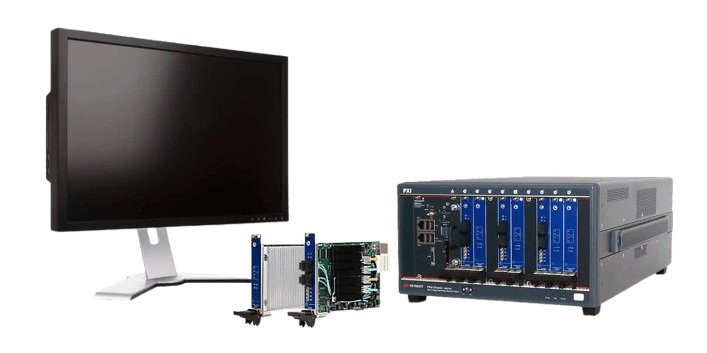
A conformance run outlasts the buffer
A wireless test instrument captures at full bandwidth until its onboard memory fills, which on a dense 5G signal is a short window. A conformance or characterization run is not short. When the buffer fills mid-run and the instrument stops to offload, the capture has a gap, and a gap in a conformance record is a test you run again.
5G bandwidth fills memory fast
Wideband capture and high sample rates reach the instrument's memory ceiling in a fraction of the run, long before the test is done.
Conformance needs an unbroken record
A conformance capture has to be continuous end to end. A record stitched across buffer offloads cannot be trusted for sign-off.
Regression needs the same signal twice
Retesting after a firmware or silicon change means replaying the exact captured signal, which a live instrument cannot reproduce on its own.
StreamStor® Cobra Recording System
One platform covers this. The Cobra takes the wideband IQ data off the signal analyzer's optical output, often a packetized VITA 49 stream, and writes it continuously at up to 20 GB/s, which is 160 Gbps. It was one of the first recorders to implement ODI for 5G test, and it records or replays a signal for seconds, minutes, or hours.
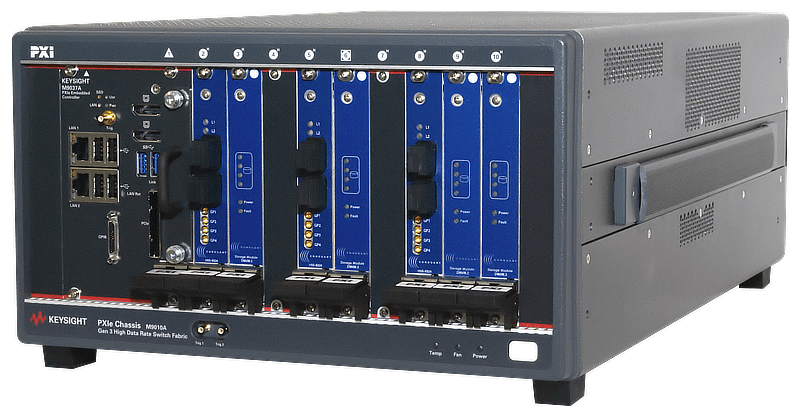
Record and playback
up to 20 GB/s (160 Gbps)
Capacity
up to 256 TB in a 4U chassis
Channels
up to 24 optical, 48 fibers
Transports
ODI, Interlaken, Serial FPDP, Aurora
- ✓Records the IQ output of a signal analyzer, and plays it back through a signal generator, for seconds, minutes, or hours
- ✓Playback loops a captured signal for repeated regression and soak runs
- ✓Peer to peer PCI Express moves the stream from the instrument to storage without a host in the path
- ✓The SDK covers .NET, C#, C++, C, LabVIEW, and MATLAB, and the system runs commanded over a network link
Why a dedicated recorder holds a rate a server cannot is covered on the high-speed data recording page. Full configurations sit with the Cobra specifications, and capacity options with the storage and drive modules. The transports that carry the test signal in are covered on the ODI and Interlaken page. Or browse all recording solutions.
Three places in a test program
The recorder shows up in three places in a communications test program. In each, it captures the digitized signal at full rate and replays it exactly when the test needs it again.
Capture a full conformance run at full bandwidth, so the record is continuous end to end and holds up for sign-off.
Replay the exact captured signal after a silicon or firmware change, so a retest runs against the same data every time.
Record a live 5G environment in the field at full rate for later analysis on the bench, when the signal of interest is one the lab cannot reproduce.
The capture works the same on the bench or in the field. The wider capture story sits on the RF and spectrum page, and the replay half on the signal playback page.
Built and supported in Longmont, Colorado
Conduant has built recording and playback systems since 1996, with hundreds of installations behind it. Design, build, and support happen in the same building, and the engineer who designed a system answers the phone about it.

- ✓Early to ODI for 5G. The Cobra was one of the first recorders to implement ODI for 5G test, so the 5G recording path is a proven part of the platform.
- ✓Tested at rate before it ships. Assembled, run at the rate it was ordered for, and verified in Longmont before it ships.
- ✓Front-end agnostic. Sits behind whichever signal analyzer, digitizer, or signal generator the lab specced, from any vendor.
- ✓Reach the engineer who built it. Support goes to the design team, with no ticket queue and no forced contract.
- ✓Custom builds in as little as 30 days. When the standard configuration does not fit, Conduant builds to the requirement.
- ✓Made and supported in the United States. Systems are engineered, assembled, and serviced in Longmont, Colorado, by US-based engineers.
Common questions
Can it capture 5G and 6G over-the-air test data?
Yes. The recorder captures the IQ output of a signal analyzer or receiver at full rate, whether the signal comes from a live over-the-air environment or a lab instrument. Capacity is configured to the length of the capture.
How long a capture window can it hold?
Capacity reaches 256 TB in a 4U chassis and scales further with configuration. The length of a continuous recording is set by that capacity and the rate off the instrument. A 5G signal records for seconds, minutes, or hours.
Does Conduant generate the test waveform?
No. The signal generator is part of your test setup. Conduant records the digital output of your instruments and replays it, and the signal generator recreates the analog signal from that playback. It is a data replay engine, not a data simulator or generator.
Does it work behind our existing test instruments?
Yes. The recorder is front-end agnostic and sits behind any vendor's signal analyzer, digitizer, or signal generator over a supported optical interface, so it drops into the test bench the lab already runs.
Tell us your instrument and your run length
Give a Conduant engineer the digitizer you run and how long the test captures. You get a straight answer on the fit.
US-based engineers available.