
Record Real-Time Data Over Xilinx Aurora
When your FPGA front end streams over AMD and Xilinx Aurora, Conduant records that data straight to disk. Aurora is the optical serial transport that carries your digitized source data from the FPGA into the recorder, over as many as 24 channels on a single board.
- Records the stream your FPGA sends over Aurora, at full rate, with no dropped samples
- Up to 24 optical channels across 48 fibers on one Cobra board
- Channels bond into fewer fast links, or run independently for many slower ones
- A direct optical path from the FPGA to the recorder
US-based engineers available.
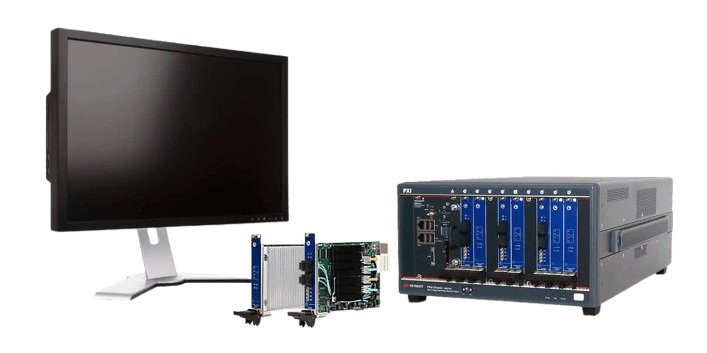
Aurora carries your FPGA data to the recorder
Many high-speed front ends are built on an FPGA, and Aurora is the serial optical transport those FPGAs already speak. When your FPGA streams its digitized data over Aurora, Conduant writes that stream straight to disk at full rate, with none of it dropped.
Built for FPGA front ends
Aurora is an AMD and Xilinx serial protocol that drops into an FPGA design, so a custom front end has a ready path out to the recorder.
Bonded or independent
Channels bond together for one fast stream, or run on their own for many slower streams, whichever the front end needs.
Twenty-four channels on a board
A single Cobra board carries up to 24 optical channels across 48 fibers, so a wide front end connects without a rack of hardware.
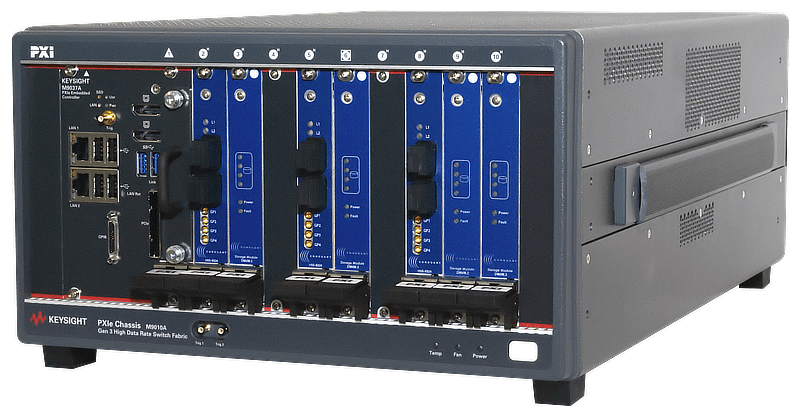
StreamStor® Cobra Recording System
The Cobra takes the Aurora stream off the FPGA's optical output and writes it continuously to removable NVMe over a peer to peer PCI Express path, with no host in the way. Whatever your front end sends, the recorder captures it as it comes in.
Transport
AMD and Xilinx Aurora
Channels
up to 24 optical, 48 fibers
Storage
removable NVMe, up to 256 TB
Data path
peer to peer PCI Express
- ✓Captures whatever your FPGA sends, at the rate it sends it, with no dropped samples
- ✓Bonds channels for one fast stream, or runs them independently for many slower ones
- ✓Removable NVMe offloads fast between runs
- ✓The SDK covers .NET, C#, C++, C, LabVIEW, and MATLAB, and the system runs commanded over a network link
The full Aurora recording system covers configurations in depth. For a source on a different transport, Conduant also records over ODI and Interlaken and 10 Gigabit Ethernet. How the recorder holds a rate end to end is on the high-speed data recording page, and capacity options with the storage and drive modules. Or browse all recording solutions.
Built and supported in Longmont, Colorado
Conduant has built recording systems since 1996, with hundreds of installations behind it. Design, build, and support happen in the same building, and the engineer who designed a system answers the phone about it.

- ✓Records out of the box. The system captures your source stream on delivery, with no acquisition software to build.
- ✓Tested at rate before it ships. Assembled, run at the rate it was ordered for, and verified in Longmont before it ships.
- ✓Front-end agnostic. Sits behind whichever FPGA or instrument the program specced, from any vendor.
- ✓Reach the engineer who built it. Support goes to the design team, with no ticket queue and no forced contract.
- ✓Custom builds in as little as 30 days. When the standard configuration does not fit, Conduant builds to the requirement.
- ✓Made and supported in the United States. Systems are engineered, assembled, and serviced in Longmont, Colorado, by US-based engineers.
Common questions
How does recording over Aurora work?
Your FPGA front end streams its digitized data over an Aurora optical link into the recorder. Conduant writes that stream straight to removable NVMe over peer to peer PCI Express, so the source data lands on disk at full rate with no dropped samples.
What is AMD and Xilinx Aurora?
Aurora is a serial optical transport protocol from AMD and Xilinx, implemented in FPGA logic. It is a common way for an FPGA-based front end to move high-speed digitized data out over optical fiber, which makes it a natural link into a recorder.
Can Aurora channels be bonded?
Yes. Channels bond together into one fast stream when a single wideband source needs the full rate, or run independently when the front end has many separate slower streams. The configuration follows what your source produces.
What Aurora configurations are supported?
A single Cobra board carries up to 24 optical channels across 48 fibers. Storage scales to 256 TB in a 4U chassis, and more with configuration, so the recorder is sized to the length of the run.
Tell us about your Aurora front end
Give a Conduant engineer your channel count and the rate each one streams. You get a straight answer on the fit.
US-based engineers available.